The Ultimate Guide to Target Heart Rate & Fitness Zones
Introduction: Why Your Heart Rate is the Key to Results
In the world of fitness, "working hard" isn't always the same as "working smart." Many people spend hours at the gym without seeing the results they desire because they aren't training at the right intensity. Your heart rate is the most honest indicator of how your body is responding to physical stress. By understanding your Beats Per Minute (BPM), you can transform your workouts from guesswork into a science-backed strategy.
This guide will walk you through the importance of heart rate monitoring, how to use our Heart Rate Calculator, and how to stay within the specific zones that align with your personal health goals—whether that is losing weight, building stamina, or peak athletic performance.
1. Why Should You Monitor Your Heart Rate?
Monitoring your heart rate provides a real-time "dashboard" for your cardiovascular system. Here is why it matters:
- Efficiency: It ensures you aren't under-training (wasting time) or over-training (risking burnout).
- Safety: Especially for beginners or those with underlying conditions, knowing your limit prevents dangerous cardiac strain.
- Fat Metabolism: Scientific studies show that the body burns a higher percentage of fat at specific lower-intensity heart rates compared to high-intensity sprints.
- Progress Tracking: As you get fitter, your heart becomes more efficient. You will notice your Resting Heart Rate (RHR) dropping over time.
2. Deep Dive: Understanding the 5 Fitness Zones
Fitness is not "one size fits all." Depending on your goal, you should aim for one of the following zones based on a percentage of your Maximum Heart Rate (MHR):
| Zone | Intensity | What Happens to Your Body? |
|---|---|---|
| Zone 1: Recovery | 50% - 60% | Great for warming up or active recovery after a hard session. Improves basic health. |
| Zone 2: Fat Burn | 60% - 70% | The "sweet spot" for weight loss. Your body utilizes stored fat as the primary fuel source. |
| Zone 3: Aerobic | 70% - 80% | Improves cardiovascular endurance. This makes your heart and lungs stronger for daily life. |
| Zone 4: Anaerobic | 80% - 90% | High intensity. You will develop "speed endurance" and a higher tolerance for lactic acid. |
| Zone 5: Red Line | 90% - 100% | Maximum effort. Only for short bursts (sprints). Used by athletes to increase peak power. |
3. The Science: How the Calculator Works
While many people use the basic formula ($220 - \text{Age}$), it is often inaccurate because it ignores your individual fitness level. Our tool uses the Karvonen Method, which factors in your Resting Heart Rate (RHR) to give a personalized result.
The Math Behind It:
$$ \text{Heart Rate Reserve (HRR)} = \text{MHR} - \text{RHR} $$
$$ \text{Target Heart Rate} = (\text{HRR} \times \text{Intensity\%}) + \text{RHR} $$
By including the RHR, the calculator adjusts for the fact that a fit person has a stronger, slower heart than someone just starting their journey.
4. How to Use the Heart Rate Calculator Tool
Follow these four simple steps to get your personalized data:
- Find Your RHR: Before getting out of bed in the morning, count your pulse for 60 seconds. This is your Resting Heart Rate.
- Input Your Age:Your maximum heart rate naturally declines as you get older.
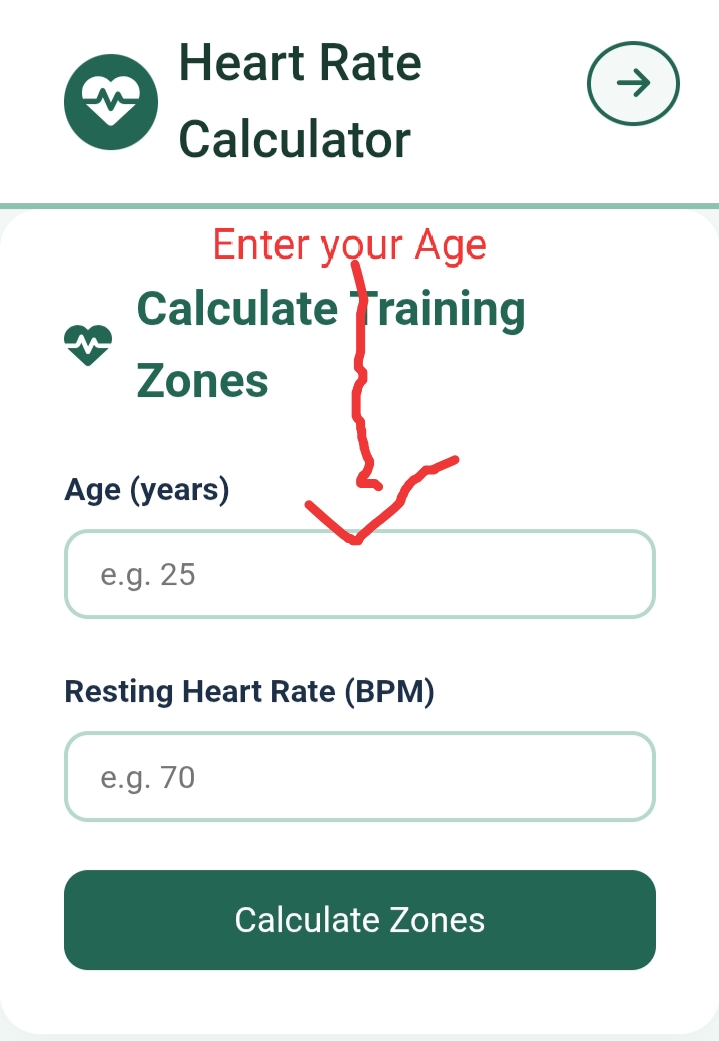
- Select Your Goal: Choose whether you want to burn fat, improve cardio, or train for performance.
- Get Your Results: The tool will provide a range. For example, if your Fat Burn range is 120-135 BPM, try to keep your heart rate in that window during your walk or jog.
5. Pro Tips for Accurate Monitoring
- Stay Hydrated: Dehydration can cause your heart rate to spike artificially (cardiac drift).
- Check for "Talk Test": In Zone 2 (Fat Burn), you should be able to speak in full sentences. In Zone 4, you should only be able to gasp out a few words.
- Don't Panic: If your heart rate goes slightly over for a minute, simply slow down. Consistency is more important than perfection.
4. Age-Specific Considerations
As we age, our physiological response to exercise changes. While the general formula provides a baseline, it is important to adjust expectations based on your life stage:
- Youth (Under 20): Highly elastic heart muscles allow for quick recovery and higher peaks. Focus on building a strong aerobic base.
- Adults (20-50): This is the peak time for "Metabolic Conditioning." Focus on Zone 2 for fat management and Zone 4 for cardiovascular longevity.
- Seniors (60+): The focus shifts to maintaining a healthy Resting Heart Rate (RHR) and ensuring you don't stay in Zone 5 for too long. Consistency is more valuable than high intensity.
5. Common Mistakes When Using a Heart Rate Calculator
To get the most out of our tool, avoid these frequent errors made by fitness enthusiasts:
A. Testing RHR at the Wrong Time
Your Resting Heart Rate should be measured when you are most calm—ideally right after waking up. Checking it after a cup of coffee or a stressful work meeting will give you an artificially high number, throwing off your Karvonen calculation.
B. Ignoring "Cardiac Drift"
During long workouts, your heart rate may slowly climb even if your pace remains the same. This is known as cardiac drift, often caused by rising body temperature and dehydration. If this happens, listen to your body rather than just the numbers.
C. The "More is Better" Fallacy
Many beginners think staying in Zone 4 or 5 is the fastest way to get fit. However, training exclusively at high intensities leads to overtraining syndrome, which can cause insomnia, irritability, and a plateau in progress. A balanced routine includes 70-80% of time in lower zones.
6. Practical Training: A Sample Week
If you are unsure how to balance these zones, here is a professional-grade training split:
- Monday: 45 mins in Zone 2 (Steady State Walk/Jog).
- Tuesday: 20 mins in Zone 4 (Interval Training).
- Wednesday: Active Recovery (Light stretching in Zone 1).
- Thursday: 30 mins in Zone 3 (Tempo Run).
- Friday: 45 mins in Zone 2 (Fat Burning focus).
- Saturday: High Intensity (Zone 5 sprints) for 10-15 mins.
- Sunday: Full Rest.
7. The Role of Technology in BPM Tracking
While the formula gives you the target, tracking it accurately is the next step. Modern wearables use Photoplethysmography (PPG)—a light-based technology—to sense blood flow through your skin. While convenient, for the most accurate results during high-intensity intervals, a chest strap monitor is recommended as it measures the electrical activity of the heart directly.
Frequently Asked Questions
Q: What is a dangerous heart rate during exercise?
A: You should generally avoid hitting your absolute Maximum Heart Rate ($220 - \text{Age}$) for extended periods. If you feel dizzy, nauseous, or have chest pain, stop immediately.
Q: Can caffeine affect my results?
A: Yes. Stimulants like coffee or pre-workout supplements can raise your resting and exercise heart rate by 5-10 BPM.
Disclaimer: This calculator is for educational purposes only. If you have a heart condition or are starting a new exercise program, please consult your doctor immediately.